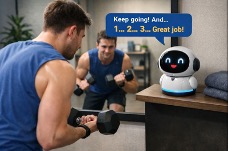
 A concept(generated with ChatGPT) illustrating the interaction in an ecoaching scenario. The idea is that the LLM-driven system (in this image embodied as a smart speaker bot) can adapt its personality and style of communication dynamically to the user’s personality and context to deliver highly situated advice experiences
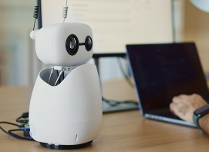 Reachy Mini – an Open-Source Robot, which we will consider to use in the project.
Project Definition
Problem Statement
Adaptive systems often fail to treat personality as a dynamic material to personalize interaction styles to the situated, moment-to-moment needs and preferences of users. Today`s LLMs have the unique potential of working with artificial/digital personalities as a designable material. However, there is limited research on how such malleable artificial personalities can be systematically applied, designed, grounded in psychological models, and leveraged in LLM-driven systems for adaptive interaction design; and, crucially, how users perceive, experience, interpret, and accept such LLM-driven advisers.
Background and Motivation
The project focuses on the interaction design, implementation, and evaluation of an adaptive adviser (potentially embodied as a small robot or a smart speaker/headset) that can use digital personalities in novel ways to support, motivate, and assist users in goal-oriented activities, such as exercising. For example, a system can map its personality-driven behavior and interaction logic to a user’s personality to choose what, when, and how to present advice to the user.
User personality is modeled using the Five-Factor Model of Personality (Big Five):
Openness, Conscientiousness, Extraversion, Agreeableness, and Neuroticism, as measured by the NEO-Five Factor Inventory (NEO-FFI). The NEO-FFI serves as a structured psychological foundation for personalizing coaching strategies, communication styles, and motivational feedback.
We already know, based on related research, that this emotion model can be used to infuse LLMs with digital personalities. However, there is limited knowledge in using a “digital twin personality” approach to create highly personalized interaction designs and experiences with LLM-driven agents.
Research Goals (examples)
- To explore the idea of “digital twin personalities” as a malleable interaction material in AI-based affective and adaptive coaching systems
- To design and prototype an adaptive personality model for an LLM-driven e-coach
- To explore how personality adaptation influences user experience, motivation, engagement, and perceived support.
- To evaluate different inclusive personality strategies in relation to user types and abilities, exercise performance, and repetition-based tasks (this can include, e.g., multilingualism)
Expected Outcomes
The project aims to contribute design insights and interaction patterns for personality-adaptive AI coaches, highlighting how artificial personality can be intentionally designed, tuned, and evaluated as part of human-AI interaction in motivational and assistive contexts. To this end, a user study needs to be performed and analyzed (mainly applying qualitative methods).
Learning Outcome
Students will experience/learn/improve:
- How to apply human-centered design methods to state-of-the-art and LLM-driven conversational user interfaces (e.g., how to conduct a user study)
- Designing and prototyping personality-adaptive interactions for LLM-driven e-coaches that respond to user traits and situated contexts.
- Evaluating user perception and experience of personality-fluid e-coaches using appropriate qualitative and quantitative methods.
- Collaborating effectively in a team and professionally communicating design and research outcomes.
Participation Requirements
- Interest: Interest in interdisciplinary work combining AI and interaction design
- Experience or willingness to dive deep into promptengineering and studying LLMs
- Experience or willingness to conduct user studies
- Experience or willingness to perform quantitative and qualitative analysis, with a stronger focus on qualitative thematic analysis
- Practical experience in programming CUIs, and a willingness to deepen their skills depending on the concrete user interface and target device
External Partner
Parallel master's theses will be performed at Aalborg University on related topics. We will try to use synergies, set up opportunities (online meetings) to exchange know-how and insights both with the students and their (co) supervisor (Assistant Prof. Dan Bennett) at Aalborg University.