Problem Description
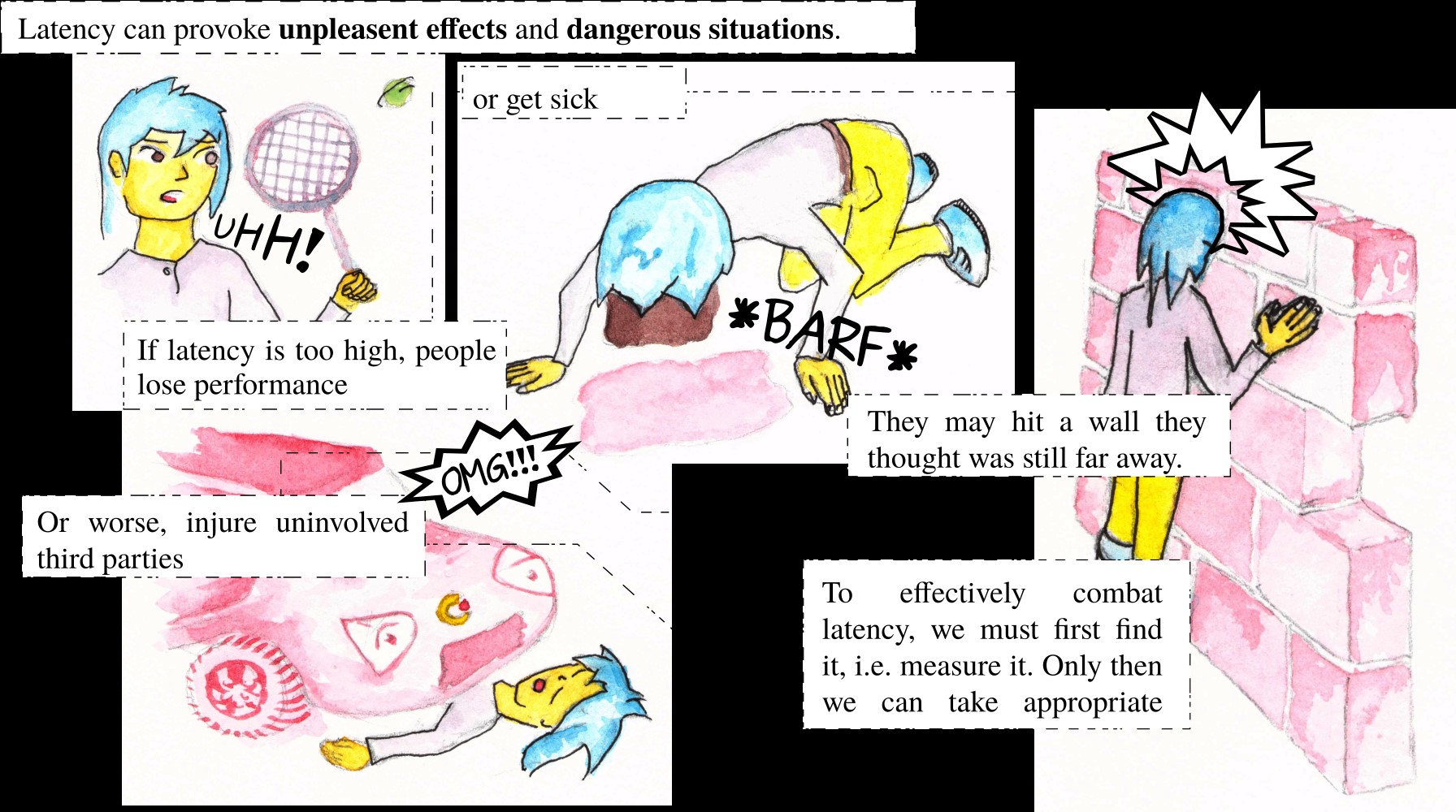
Latency can be detrimental for the experience of Virtual Reality. High latency can lead to loss of performance and cybersickness. There are simple approaches to measure approximate latency and more elaborated for more insight into latency behavior. When talking about latency, we usually refer to Motion To Photon Latency or End To End Latency. Motion To Photon latency is the time from starting a movement that is tracked and fed into the VR simulation to create the next frame, until the image corresponding to the movement is shown on the VR device screen.
Project Definition
There are different methods to measure the Motion to Photon Latency in VR applications. What these methods have in common, is that we basically have to record both the real motions performed by the user, as well as the visual output of the VR applications to be able to detect the virtual motion. In this Guided Project, we want to implement and compare several of these methods to measure latency in a prototypical VR application, e.g.:
- Frame counting: A high speed camera records the user and a screen that displays the graphical output of the VR environment. Extract and compare the timestamp of peak acceleration in the video of the real motion and oft he virtual motion (Friston et al.). Sine Fitting: Attach a tracked object to a pendulum, render the position of the tracked object to a screen. A high-speed camera records both the real and the virtual pendulum. Extract positions of the object from video via thresholding automatically. Fitting a sine curve to the position prevents inaccuracies of the thresholding, and low sampling frequency in the video (Steed et al.).
Learning Outcome
Students develop VR applications, perform video analysis, design and conduct experiments, and learn how to perform data analysis.
Participation Requirements
Students benefit from prior experience with:
- Real-time 3D rendering, graphics programming, or interaction in VR.
- 3D game engines such as Unity / Unreal, and programming concepts (C# / C++).